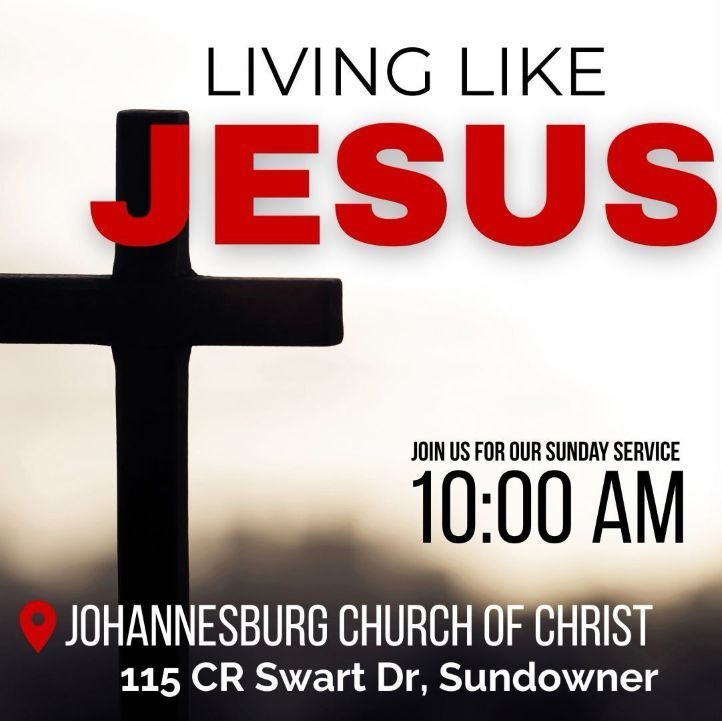
Living Like Jesus – by Jake Graham

January 25, 2026

Sermon recap:

The need for Jesus is seen from Book of Genesis 1:1–2, when light came into the world; we are the image of God, so how we interact reflects him, yet the choice of the two trees shows that independence leads to billions of problems and we need the solution—Jesus (Gospel of Matthew 4; 26; Epistle to the Philippians 4; Epistle to the Colossians 1), who brings healing, peace, victory, and triumph.

The impact of Jesus continues in Acts of the Apostles 4–5:28–39—His ways are still taught, people still gather in His name, and lives are still transformed—so it is important for us to have Jesus, not honour or glory, and to live like Him as the Teacher, the Shepherd, and the Evangelist. If you missed this service, you can watch it on our YouTube channel. The lesson starts at 42 mins.

September 13, 2026
Because Jesus reconciled us to God through the cross, we are called to pursue reconciliation with God, one another, and the world around us.
September 6, 2026
Jesus reconciles us to the Father and teaches us to extend his grace, helping us forgive one another, heal relationships, and walk together in peace.
By Justin Renton • September 2, 2026
The physics of the pendulum Picture an old grandfather clock in a quiet hallway. Its long brass pendulum swings steadily: tick, tock, tick, tock. Now give that pendulum a hard shove to the right. It does not simply glide back to the center and stop. It races right past the middle and sways just as far to the left. Left to its own momentum, a pendulum never rests at either extreme; it finds peace only when it hangs still at the center, held by gravity and its fixed point. The church behaves in much the same way. Push her too far toward one side of a truth and she does not gently settle into balance, she swings. Often for a whole generation toward the opposite error, and then back again, wounding people at both ends of the arc. And here is the crucial thing the clock teaches us: the pendulum comes to rest not by being frozen in place, but by being held. Balance is not the absence of force; it is the fixed point that keeps opposing pulls in tension so that the weight can finally hang still.
Show More